Neid Fire Churn
29-Sep-23: I am currently re-writing the Neid Fire section - I will include more detail on building a Neid Fire apparatus over time. I will also include suggestions on how to adopt in ritual.
The Neid Fire Ritual Apparatus - Fire Churns \ Fire Gates
According to many descriptions, the traditional Neid Fire ritual used a friction fire apparatus that I call a fire churn (fire gate in Russia.) It's basically a super sized strap drill!
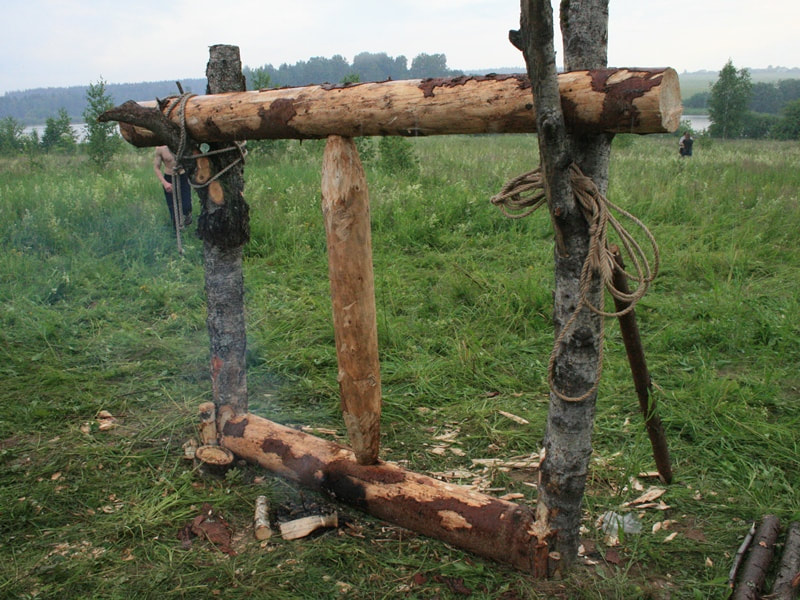
As picture below the apparatus consists of a large wooden frame to support a large heavy cross bar (bearing log) of heavy dense wood which would have a hole made in the centre (I suggest forcing a thick leather into the hole to help reduce friction at the top.) A large hearth log would be placed at the base with a shallow hole carved and with a notch (similar to bow drill hearths but on a larger scale.) A straight log about 6 feet tall, and up to about a foot in diameter sometimes referred to as the auger ( spindle) would be carved at each end with a narrow point at the top and a more shallower point at the bottom but you would still want the bottom to be quite narrow as otherwise it will be quite difficult to gain enough friction to coax an ember. The spindle would be placed vertically between the cross bar and hearth. The spindle would need to be carved as straight as possible and would need to be placed as vertical as possible. A long heavy rope would be tightly wrapped several times around the middle of the spindle with an end of the rope on opposite sides and this would be pulled in rhythm.
According to many descriptions, the traditional Neid Fire ritual used a friction fire apparatus that I call a fire churn (fire gate in Russia.) It's basically a super sized strap drill!
As picture below the apparatus consists of a large wooden frame to support a large heavy cross bar (bearing log) of heavy dense wood which would have a hole made in the centre (I suggest forcing a thick leather into the hole to help reduce friction at the top.) A large hearth log would be placed at the base with a shallow hole carved and with a notch (similar to bow drill hearths but on a larger scale.) A straight log about 6 feet tall, and up to about a foot in diameter sometimes referred to as the auger ( spindle) would be carved at each end with a narrow point at the top and a more shallower point at the bottom but you would still want the bottom to be quite narrow as otherwise it will be quite difficult to gain enough friction to coax an ember. The spindle would be placed vertically between the cross bar and hearth. The spindle would need to be carved as straight as possible and would need to be placed as vertical as possible. A long heavy rope would be tightly wrapped several times around the middle of the spindle with an end of the rope on opposite sides and this would be pulled in rhythm.
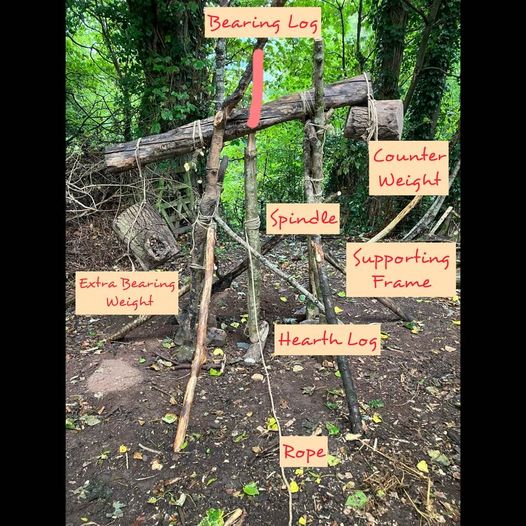
A Neid Fire ritual apparatus in my back garden made in 2023
|
The sourcing and preparing of the materials needed to build the Neid Fire ritual apparatus can take time - I spent many months scouring the woods looking for suitable wind fallen branches and then months to season them and then time to carve them - all done with awareness and intention.
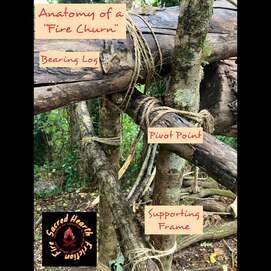
These devices aren't meant to be quick or effective but are meant to take time to prepare and time to use and they need to be used comunally with everyone working on harmony. Songs or chants may have been used and a call-response definitely helps keep rhythm. These can work beautifully when everyone is in sync - it is not a tug of war and it is to be used with awareness and intention. They do take time to setup and tweak so they are working smoothly - you need to ensure the frame is secure and the bearing log doesn't fall off! I tie a horizontal piece of wood to the bearing log and use as a pivot point by tying to the frame - the other end is allowed to move dowwards as the spindle wears away and gets shorter. You may also need to add extra weight to the bearing log (and if so a counter weight on the other end) It can take a bit of experimentation to get it to work! And this is the whole point - to work together to build something ridiculously over engineered to ritually welcome the fire! |
|
According to some folklore, nine nines of first begotten son’s were required to pull the rope to “churn” the auger into the hearth log! Much can be incorporated into the ritual depending on where you are drawing from the land and local traditions ; time of year and in response to an event.
Apparently according to the various accounts, Oak was commonly used due to it's perceived sacredness by both the Celts and Slavs (and Oak does indeed work with the bow drill but is difficult to find and I would not endorse cutting live Oak.)
I have also read descriptions of slightly different apparatus including spinning wheels, cart wheels, and augers being horizontally driven into wood - though I'm unsure how that would work and am suspicious of those written accounts about the horizontal churn. I have tried a horizontal churn and due to the nature of friction, it is very difficult to achieve the necessary pressure and friction horizontally. I'm also intrigued by the use of wheels and will have to try them one day!
I have come across various reconstructions, though only one other in the UK I am aware of is the one by the artist Tim Knowles as part of the 2015 Helmsdale Highland Games, There have been numerous ones within Eastern Europe; Baltics and Russia.
Apparently according to the various accounts, Oak was commonly used due to it's perceived sacredness by both the Celts and Slavs (and Oak does indeed work with the bow drill but is difficult to find and I would not endorse cutting live Oak.)
I have also read descriptions of slightly different apparatus including spinning wheels, cart wheels, and augers being horizontally driven into wood - though I'm unsure how that would work and am suspicious of those written accounts about the horizontal churn. I have tried a horizontal churn and due to the nature of friction, it is very difficult to achieve the necessary pressure and friction horizontally. I'm also intrigued by the use of wheels and will have to try them one day!
I have come across various reconstructions, though only one other in the UK I am aware of is the one by the artist Tim Knowles as part of the 2015 Helmsdale Highland Games, There have been numerous ones within Eastern Europe; Baltics and Russia.
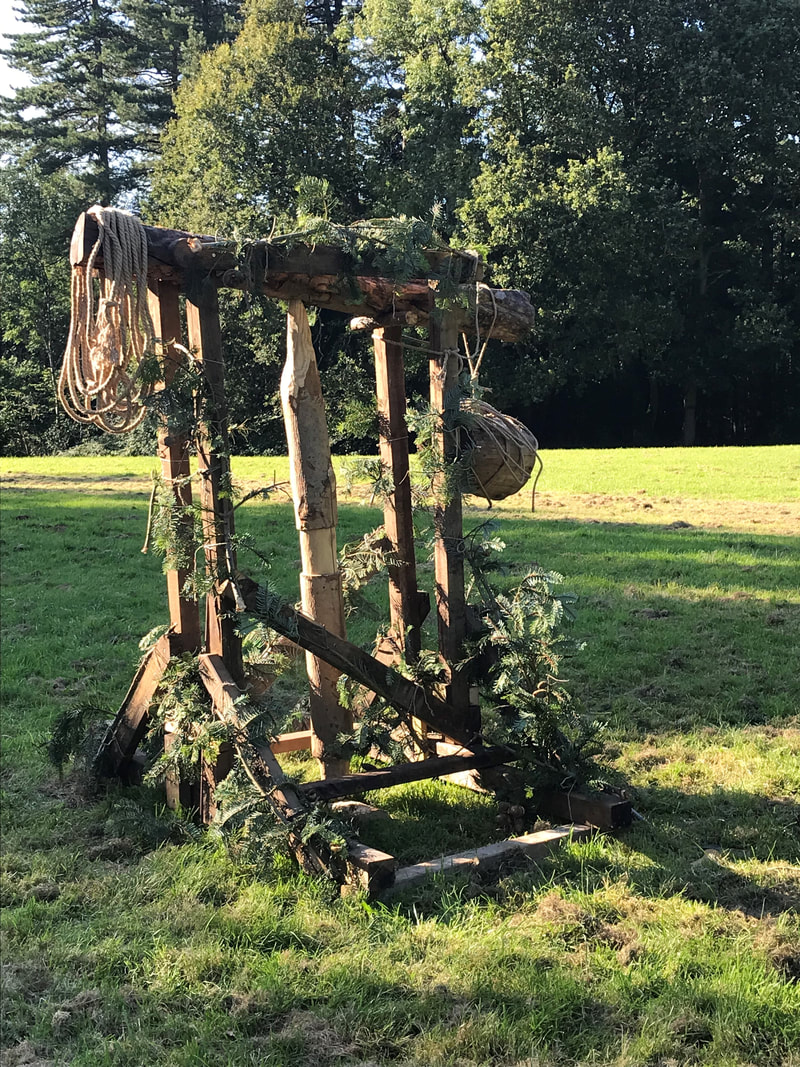
My reconstruction of a Fire Churn used at the Erti Suli Gatering 2018-2021 and wokred beautifully
|
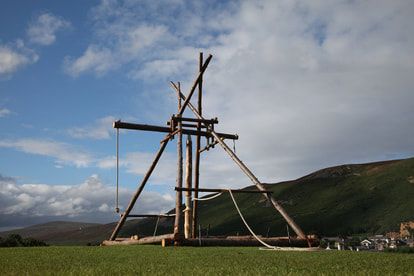
Force Fire an art installation used to start the Helmsdale Highland Games in 2015 by the artist Tim Knowles. (The perspective makes it look a lot larger that it actually was! See video further below.) Click photo to go to Tim Knowles Force Fire web page.
|
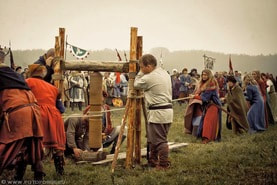
A Slavic Fire Churn reconstruction at an Ivan Kupala festival. Click photo to be taken to an interesting article.
|
A "Force Fire" churn being used as part of a ceremony by a Viking re-enactment group in Poland in 2013. Photo by www.fotoforge.eu.
Click photo for more photos of this ceremony by FotoForge.
|
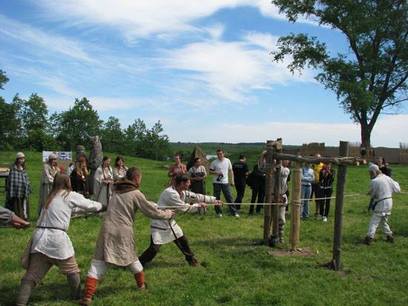
A Fire Churn reconstruction in Belarus, at the celebration of Prince Bryachislav's 945th birthday. Guests from Belarus, Lithuania, Latvia, Estonia, Russia and Tajikistan came to the holiday "Braslavskie Lapidary". Braslav regional executive committee, Braslav museum association, with the participation of Nansan commercial enterprise, organized a small festival of medieval culture "The Sword of Bryachislav", in which knights, artisans, musicians, dancers, historians and archaeologists participated. The festival began with the ritual of the Living Fire archaic method, the secret of which lies not only in the friction of the tree. the fire obtained in this way was considered sacred, and the attitude to it was especially tremulous (google translated from http://www.tio.by/info/novosti/1883/
Videos
|
|
|
|
|
IMG_0867 (1) from Timespan on Vimeo. |